

When God Hates People That You Do

Only ‘Fragile Bubbles’ Need Drastic Defense of Excommunications and Shunnings
Dai Slee [New South Wales, Australia, Christian who commented on Facebook on 9/30/2016 about excommunication/shunning.]Amen. It was always in the back of my mind that there had to be a serious lack of faith in the Almighty God if shunning was necessary. Only fragile bubbles need that kind of drastic defense.
“Fragile bubbles.” This was certainly true of my ex-church Grace Bible Fellowship of Silicon Valley and the abusive pastors/elders who are authoritarian, demand ‘obedience’ [their claims are completely un-Biblical and they claim fraudulent authority, see Pastor Wade Burleson’s blog and short book of this title on Amazon]. Excommunication/shunnings for ANY trumped up charge, not immorality.
The GBFSV pastors/elders Cliff McManis, Sam Kim, Tim Wong, Bob Douglas and others over-step their bounds into the lives of adults in which it is NONE of their business or their right to control. They should be in professional therapy and groups to deal with their complete lack of basic, adult healthy boundaries, their arrogance, pride, and sense of entitlement.
*************************************************************
Psychologist/Therapist/Best-selling author/Thought Reform expert/Cult Expert Steve Hassan
Steven Hassan’s BITE Model of Cult Mind Control
Many people think of mind control as an ambiguous, mystical process that cannot be defined in concrete terms. In reality, mind control refers to a specific set of methods and techniques, such as hypnosis or thought- stopping, that influence how a person thinks, feels, and acts. Like many bodies of knowledge, it is not inherently good or evil. If mind control techniques are used to empower an individual to have more choice, and authority for his life remains within himself, the effects can be beneficial. For example, benevolent mind control can be used to help people quit smoking without affecting any other behavior. Mind control becomes destructive when the locus of control is external and it is used to undermine a person’s ability to think and act independently.
As employed by the most destructive cults, mind control seeks nothing less than to disrupt an individual’s authentic identity and reconstruct it in the image of the cult leader. I developed the BITE model to help people determine whether or not a group is practicing destructive mind control. The BITE model helps people understand how cults suppress individual member’s uniqueness and creativity. BITE stands for the cult’s control of an individual’s Behavior, Intellect, Thoughts, and Emotions.
It is important to understand that destructive mind control can be determined when the overall effect of these four components promotes dependency and obedience to some leader or cause. It is not necessary for every single item on the list to be present. Mindcontrolled cult members can live in their own apartments, have nine-to-five jobs, be married with children, and still be unable to think for themselves and act independently.
We are all subject to influence from our parents, friends, teachers, co-workers… When this influence helps someone grow and maintain an internal locus of control, it is healthy. Influence which is used to keep people mindless and dependent is unhealthy. To download a PDF of the Influence Continuum graphic, click here.
Destructive mind control is not just used by cults. Learn about the Human Trafficking BITE Model and the Terrorism BITE Model.
The BITE Model
I. Behavior Control II. Information Control
III. Thought Control IV. Emotional Control
Behavior Control
1. Regulate individual’s physical reality
2. Dictate where, how, and with whom the member lives and associates or isolates
3. When, how and with whom the member has sex
4. Control types of clothing and hairstyles
5. Regulate diet – food and drink, hunger and/or fasting
6. Manipulation and deprivation of sleep
7. Financial exploitation, manipulation or dependence
8. Restrict leisure, entertainment, vacation time
9. Major time spent with group indoctrination and rituals and/or self indoctrination including the Internet
10. Permission required for major decisions
11. Thoughts, feelings, and activities (of self and others) reported to superiors
12. Rewards and punishments used to modify behaviors, both positive and negative
13. Discourage individualism, encourage group-think
14. Impose rigid rules and regulations
15. Instill dependency and obedience
16. Threaten harm to family and friends
17. Force individual to rape or be raped
18. Instill dependency and obedience
19. Encourage and engage in corporal punishment
Information Control
1. Deception:
a. Deliberately withhold information
b. Distort information to make it more acceptable
c. Systematically lie to the cult member
2. Minimize or discourage access to non-cult sources of information, including:
a. Internet, TV, radio, books, articles, newspapers, magazines, other media
b.Critical information
c. Former members
d. Keep members busy so they don’t have time to think and investigate
e. Control through cell phone with texting, calls, internet tracking
3. Compartmentalize information into Outsider vs. Insider doctrines
a. Ensure that information is not freely accessible
b.Control information at different levels and missions within group
c. Allow only leadership to decide who needs to know what and when
4. Encourage spying on other members
a. Impose a buddy system to monitor and control member
b.Report deviant thoughts, feelings and actions to leadership
c. Ensure that individual behavior is monitored by group
5. Extensive use of cult-generated information and propaganda, including:
a. Newsletters, magazines, journals, audiotapes, videotapes, YouTube, movies and other media
b.Misquoting statements or using them out of context from non-cult sources
6. Unethical use of confession
a. Information about sins used to disrupt and/or dissolve identity boundaries
b. Withholding forgiveness or absolution
c. Manipulation of memory, possible false memories
Thought Control
1. Require members to internalize the group’s doctrine as truth
a. Adopting the group’s ‘map of reality’ as reality
b. Instill black and white thinking
c. Decide between good vs. evil
d. Organize people into us vs. them (insiders vs. outsiders)
2.Change person’s name and identity
3. Use of loaded language and clichés which constrict knowledge, stop critical thoughts and reduce complexities into platitudinous buzz words
4. Encourage only ‘good and proper’ thoughts
5. Hypnotic techniques are used to alter mental states, undermine critical thinking and even to age regress the member
6. Memories are manipulated and false memories are created
7. Teaching thought-stopping techniques which shut down reality testing by stopping negative thoughts and allowing only positive thoughts, including:
a. Denial, rationalization, justification, wishful thinking
b. Chanting
c. Meditating
d. Praying
e. Speaking in tongues
f. Singing or humming
8. Rejection of rational analysis, critical thinking, constructive criticism
9. Forbid critical questions about leader, doctrine, or policy allowed
10. Labeling alternative belief systems as illegitimate, evil, or not useful
Emotional Control
1. Manipulate and narrow the range of feelings – some emotions and/or needs are deemed as evil, wrong or selfish
2. Teach emotion-stopping techniques to block feelings of homesickness, anger, doubt
3. Make the person feel that problems are always their own fault, never the leader’s or the group’s fault
4. Promote feelings of guilt or unworthiness, such as
a. Identity guilt
b. You are not living up to your potential
c. Your family is deficient
d. Your past is suspect
e. Your affiliations are unwise
f. Your thoughts, feelings, actions are irrelevant or selfish
g. Social guilt
h. Historical guilt
5. Instill fear, such as fear of:
a. Thinking independently
b. The outside world
c. Enemies
d. Losing one’s salvation
e. Leaving or being shunned by the group
f. Other’s disapproval
6. Extremes of emotional highs and lows – love bombing and praise one moment and then declaring you are horrible sinner
7. Ritualistic and sometimes public confession of sins
8. Phobia indoctrination: inculcating irrational fears about leaving the group or questioning the leader’s authority
a. No happiness or fulfillment possible outside of the group
b. Terrible consequences if you leave: hell, demon possession, incurable diseases, accidents, suicide, insanity, 10,000 reincarnations, etc.
c. Shunning of those who leave; fear of being rejected by friends, peers, and family
d. Never a legitimate reason to leave; those who leave are weak, undisciplined, unspiritual, worldly, brainwashed by family or counselor, or seduced by money, sex, or rock and roll
e. Threats of harm to ex-member and family
Jessica Fore, a Victim of Domestic Violence, Is Indicted by The Presbyterian Church of America for Contempt Toward the Church and Its Leaders —
The PCA contributes to the abuse of a domestic violence survivor. Shame on them!
Rachel Miller and the Missing CBMW Posts on the Eternal Subordination of the Son —
Why does CBMW secretly delete inconvenient articles?
via Rachel Miller and the Missing CBMW Posts on the Eternal Subordination of the Son —
Why 1 Timothy 2:8-15 Does Not Ban Women from Teaching & Having Authority in the Church — The Junia Project
From the mailbox: “Just wanted to say thank you for your article on 1 Timothy 2. It was a great reference for me as my 13 yr old daughter asked me about it when she read it during her devotions. I was not sure how to respond to her until I found your article. Thank…
Developing healthy boundaries, is not about hating people, being mean, or wanting to hurt people back ~ Lilly Hope Lucario

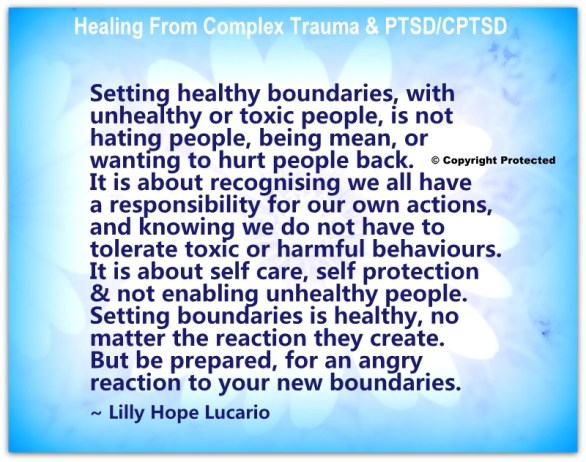
Developing, implementing and maintaining healthy boundaries, is not easy. It feels weird, especially when you are someone who has always had soft boundaries.
I talk a lot about emotional boundaries, because I know they are vital in not being harmed anymore. They also help people control their emotional reactions and responses. I’ve had to learn boundaries and not get upset and react immediately at someone being hurtful, or toxic. I’ve spent a lot of energy learning self control, and I am consistently better at this.
Toxic/unhealthy people, will demand your boundaries are harmful. Of course they will, they don’t want you to implement something that stops them trampling over you emotionally. It will bug the shit out of toxic people, that they are no longer able to upset you, or they can’t do and say what they want. And in their entitled selfish minds, they should be allowed to do…
View original post 772 more words
Having Healthy Boundaries

This Is What It Means To Be Included

“This is what it means to be included.”
The mother’s words jumped out at me from the radio.
Included.
Two year old Tatum Bakker had never been able to swing on a playground swing set until they visited Brooklyn’s Playground on their way through Pocatello, Idaho. It’s a playground designed for children who are physically able and for those who are less able to play on together, named for the little girl who started it all, Brooklyn Fisher.
 Photo: http://brooklynsplayground.org/
Kids with conditions like spina bifida usually can’t take part in playground games and activities, kids like seven year old Brooklyn and two year old Tatum, but in Pocatello they can. As Tatum’s mother explained:
And I put Tatum in a swing and kind of sat back and absorbed it all, and looked up and saw an older child, maybe 10 or 12 – a little girl – in a…
View original post 675 more words
When People Show You Who They Are

 GBFSV SPIRITUAL ABUSE VICTIMS' RECOVERY